Ingredient Files
Pronounced THAL-ates. And other things hiding in your soap
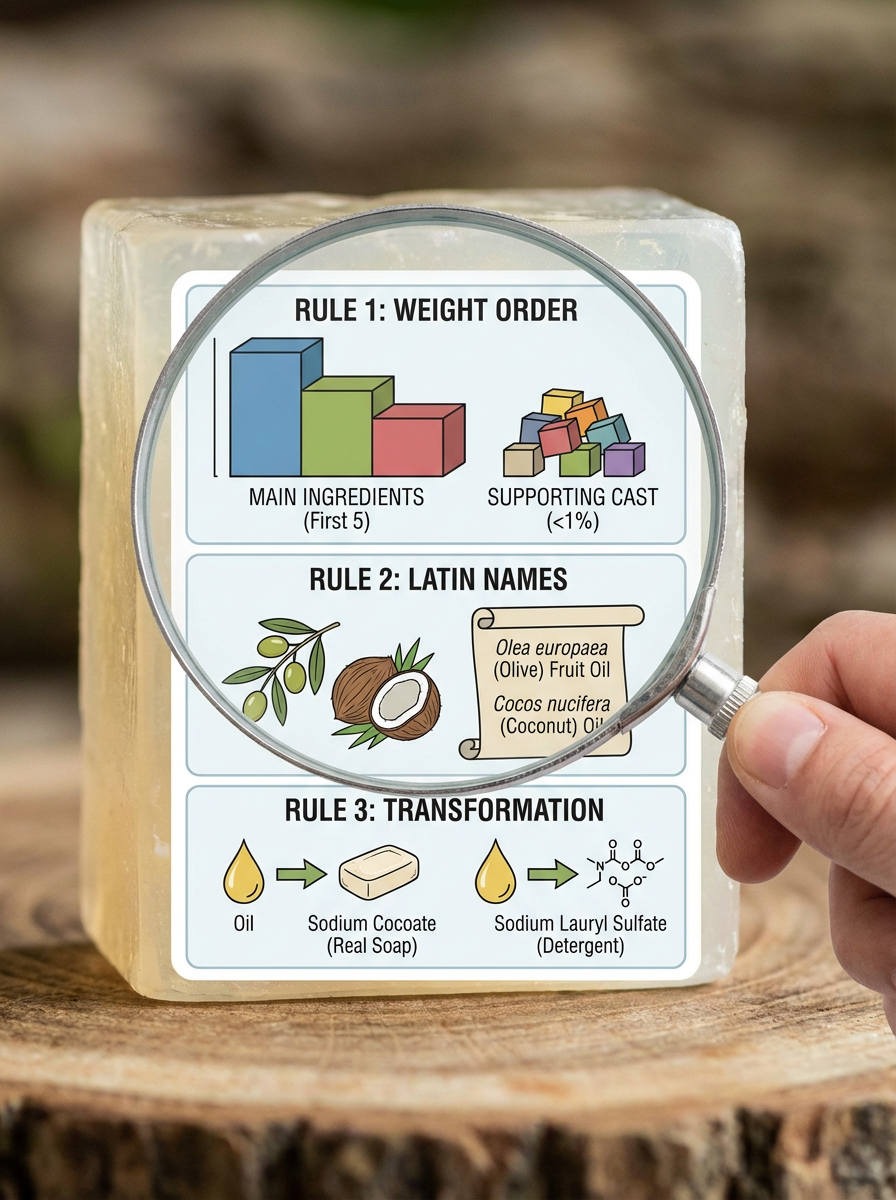
How to read a soap ingredient label
The label rules no one taught you
In the US, personal care products disclose ingredients under the INCI system — International Nomenclature of Cosmetic Ingredients. Three rules you need:
1. Ingredients are listed by weight, highest to lowest — but only down to 1%. After that, the order is at the manufacturer's discretion. So the first five entries tell you what the product is. Everything after is the supporting cast.
2. Plant oils go by Latin binomial plus common name. Olive oil shows up as Olea europaea fruit oil. Coconut oil is Cocos nucifera oil. That's not greenwashing — that's regulation. What is greenwashing is a product screaming "with coconut oil!" on the front when coconut oil is ingredient #17.
3. Everything that happened to the oil gets a different name. Coconut oil that's been saponified into real soap becomes sodium cocoate. Fine. That means exactly what it sounds like. Coconut oil that's been torn down into lauric acid and rebuilt as a detergent becomes sodium lauryl sulfate. That is not the same thing. More on this in a second.
The usual suspects
Here's what to look for — and what the chemistry actually says.
Sodium lauryl sulfate (SLS) / sodium laureth sulfate (SLES)
These are detergents. Not soaps — detergents. The difference matters: a true soap is a fatty acid neutralized with a base (olive oil meeting lye in a pot). A detergent is a synthesized surfactant engineered to foam cheaply in hard water.
Here's the part that should stop you mid-scroll: SLS is used as the control substance in dermatology research — scientists apply it to skin in order to deliberately damage the barrier, then study the damaged skin. A single 24-hour patch at a modest concentration spikes transepidermal water loss (the rate your skin leaks moisture) by roughly eight times baseline, and the barrier disruption can last close to a week. It also nudges the skin microbiome toward pathogenic species and suppresses the enzymes your skin uses to shed dead cells properly.
It's the cheapest way to make something foam. That's the whole reason it's in everything.
"Fragrance" or "Parfum"
This is the one that should make you angry.
Under the US Fair Packaging and Labeling Act, the word "fragrance" is a protected trade secret. A single listing of "fragrance" on an ingredient panel can legally conceal dozens — sometimes hundreds — of individual chemicals, and the manufacturer is not required to disclose any of them to you.
The reason this matters in practice: the most common phthalate used in personal care, diethyl phthalate (DEP), is added to fragrance blends to make the scent linger. Phthalates are endocrine disruptors — they mimic or block your own hormones. CDC biomonitoring has found DEP metabolites in essentially 100% of Americans tested. Prenatal phthalate exposure has been correlated with preterm birth, impaired reproductive development in male infants, and elevated childhood asthma risk. The EU has banned several phthalates from cosmetics. The US has not.
When you see "fragrance" on a label, read it as: a legal black box that may contain phthalates, synthetic musks, and allergens I will never be told about.
Parabens (methylparaben, propylparaben, butylparaben, etc.)
Preservatives. They suppress microbial growth in water-containing products. The concern: they're weak estrogen mimics, and several have been flagged by European regulators as endocrine disruptors of concern. Denmark banned propylparaben outright in products for children under three.
Here's the thing — in a proper cold-process soap bar, you don't need them. The high pH during cure and the low water activity in a finished bar naturally suppress microbes. When parabens show up in something labeled "soap," it's usually because the product isn't actually soap — it's a syndet bar (synthetic detergent pressed into a soap shape) that would otherwise grow mold.
Sodium tallowate / sodium lardate
Saponified beef fat or pork fat. It's a legitimate soapmaking ingredient with centuries of history — but if a brand is selling you "pure, natural, gentle" without disclosing that there's rendered livestock in the bar, that's a disclosure failure. And if you're vegan, or you just want the option, you deserve to know.
EDTA / tetrasodium EDTA
A chelator. It grabs hard-water minerals so a detergent-based formula can foam. Fairly benign on skin, but it's environmentally persistent — it doesn't break down readily in wastewater, and it has a documented capacity to mobilize heavy metals in river sediment. Soapmakers who build a formula that works in hard water from the start don't need it.
What the label doesn't tell you
The label tells you what's in the bar. It does not tell you what happened to get those molecules into the bar.
Palm oil. Indonesia and Malaysia produce roughly 85% of the world's palm oil, on land that was once an orangutan rainforest. About 80% of wild orangutan habitat has been cleared or degraded. Plantations in that region have documented use of child and forced labor, and orangutans that wander into them are treated as pests. RSPO "sustainable" palm certification exists but is widely criticized for weak enforcement. Palm oil also hides on ingredient panels under more than a hundred different derivative names — sodium palmate, palmitic acid, cetyl alcohol, glyceryl stearate, stearic acid, and on and on. If a label doesn't actively declare palm-free, assume palm is in there somewhere.
Non-fair-trade shea, coconut, cocoa. The cooperatives that grow these crops in West Africa and across South and Southeast Asia are often staffed by women earning below subsistence. Fair trade sourcing isn't a marketing flex — it's the difference between a worker being able to feed her kids and not. The label won't tell you which one you're buying. The brand has to.
Animal testing. The US does not ban cosmetic testing on animals. The EU, UK, India, Israel, and others do. Rabbits are still used in the Draize test — an eye and skin irritation protocol — for products sold into jurisdictions that require it. "Cruelty-free" has no legal definition in the US, which is why brands that actually mean it say so loudly, name their certifying body, and can document it up their supply chain.
What a clean label looks like
Here's what every Cleanpunk bar's ingredient list will and won't show you — and Robin's Secret Garden is a good one to go look at while the vocabulary is fresh: cleanpunk.shop/us/products/robins-secret-garden
Open the page, scroll to the ingredients, and run it through what you just learned:
No "fragrance" as a black box. Every scented Cleanpunk bar uses phthalate-free fragrance or essential oils, named on the label.
No palm, in any of its hundred aliases. Every Cleanpunk bar is palm-free. No RSPO asterisk, no hidden derivatives.
No SLS / SLES. We're true cold-process soap. The saponified fair-trade oils do the lathering.
No parabens, no EDTA, no synthetic dyes. Color comes from mica and mineral pigments. Sparkle, where there is any, is mineral — never plastic glitter.
No tallow, no animal-derived anything. No animal testing. Ever.
You will see fair-trade olive oil, coconut oil, and shea butter — sourced from suppliers we can name.
That's the whole difference. Not magic, not marketing — just the result of a decision, made early, that every bar would have a label we could defend line-by-line.
And every bar still funds the sanctuary. No salaries, no overhead, 100% volunteer-run. The animals at Steampunk Farms Rescue Barn eat because you lather.
Why I wrote this
Because a person who knows how to read a label doesn't need me to tell them which soap to buy. They can walk into any store on the planet and figure it out themselves.
I'd rather have ten thousand readers who can do that than ten thousand customers who can't.
The Soap Lab on the site goes deeper on each of these ingredient classes, with the studies linked so you can check my work. We're adding pieces there every few weeks. The Cold Press will bring you the best of it — no more than twice a month, and never without something you can actually use.
Thanks for reading.
— Krystal Cleanpunk | Soap Lab
P.S. Forward this to someone who still buys the $3 bar and thinks it's the same thing. They will not thank you this week. They will, eventually, thank you.
Also from Cleanpunk
The soaps the chemistry is about
Small-batch cold-process bars made in the same lab these articles come from.
SanctuaryMeet the animals
Every bar funds rescue, feed, and vet care at Steampunk Farms Rescue Barn.
StandardsWhat we will and won't put in a bar
Cruelty-free, palm-free, and the reasoning behind both.